
Why Aren't the Rules the Rules? (Part 2)

Dear Sports Fan,

Reading about the bad call in the Pittsburgh/Atlanta game last night reminded me of something I’ve always wondered. Whether it’s because the ref is looking the other way (literally or figuratively), or because of just plain human error, the rules in sports are often either not enforced, or not enforced correctly. But in many cases, it seems like people just consider that an integral part of the game! Especially given the increasing ability of technology to settle disputes, why not just come up with what the real rules ought to be, and then enforce them as thoroughly as possible?

Thanks,
Erik

— — —

(This is a continuation of an answer to this question. The first half was posted here.)

It will ruin the game:

There is some concern that adding technology to sports will ruin the game by making it too sterile or too slow. Taking the humanity out of the game could be a concern, but as much as people love discussing disputed calls at the water cooler, they also love talking about great (and terrible) performances, and great (and terrible) decisions on the part of the players and coaches. There will always be something to talk about. As for making the game too slow… uh… it could not possibly slow down the game as much as television time-outs, arguing with refs about calls, or in the case of baseball… adjusting your batting gloves, hat, glove, or cup compulsively over and over and over again.

It’s too expensive:

FIFA, the notoriously frustrating international federation of soccer refuses to add video replay to international competition because it would be too expensive for some of its member nations to implement. This is a curious reason since it seems like knowing ahead of time that you will actually know whether the ball crossed the goal line during the game shouldn’t change any element of tactics or strategy.

What do you mean “right?”

This is the heart of the answer to your question. A rule says, “it’s against the rules to trip an opponent” but does that mean “it’s against the rules to trip an opponent” or “it’s against the rules to trip an opponent if you get caught?” It’s clear from these two sports cliches which way the sports world leans: “it’s not a foul if you don’t get caught” and “if you’re not cheating, you’re not trying.”

Sports, particularly baseball is all about cheating. The last twenty years have been shaped by steroids and HGH. Before that there were amphetamines called greenies. Before that teams regularly intimidated officials or just plain assaulted them when they didn’t like the calls they were getting. It’s well know that the 1919 World Series was fixed by a few players on the White Sox and there have always been unproven rumors that the 1918 one might have been fixed as well. Cyclists are jam-packed full of drugs. They have been for a long time but “tiny electric motors…?” That’s a new one.

Even if a player is clean when he steps onto the court, he or she is rarely clean by the end of the game. Some of the most memorable plays in sports history have been the beneficiaries of some incorrect or missed calls. In soccer there is the “hand of god” goal, in basketball, Michael Jordan’s famous shot to beat the Utah Jazz is an offensive foul. Watch the video and notice Jordan’s left hand on his defender’s hip… he definitely pushes off.

Jordan is not great in spite of pushing off, he’s great partially because he pushed off and didn’t get caught.

Another way to state the question is — do we really want to have the game called “perfectly?” Here’s an example of this in the non-sports world. We certainly have the technology to identify each car and driver and what road they are on. Why shouldn’t we simply fine people whenever they go over the speed limit? Why waste all the time, money, and talent of our police departments lurking around trying to catch people when we could just automate it? I know we’ve started doing this with running some red lights, but I think that if we tried to automate speeding tickets on a large scale there would be riots and political parties would shape up around the issue… and I’m not sure which would be worse! It’s the same with most sports — a totally policed game is a boring one.

Thanks for the fun question,
Ezra Fischer
Why Aren't the Rules the Rules?

Dear Sports Fan,

Reading about the bad call in the Pittsburgh/Atlanta game last night reminded me of something I’ve always wondered. Whether it’s because the ref is looking the other way (literally or figuratively), or because of just plain human error, the rules in sports are often either not enforced, or not enforced correctly. But in many cases, it seems like people just consider that an integral part of the game! Especially given the increasing ability of technology to settle disputes, why not just come up with what the real rules ought to be, and then enforce them as thoroughly as possible?

Thanks,
Erik


Dear Erik,

Great question! In fact, this is such an interesting question that I’m going to break my answer into a couple blog posts.

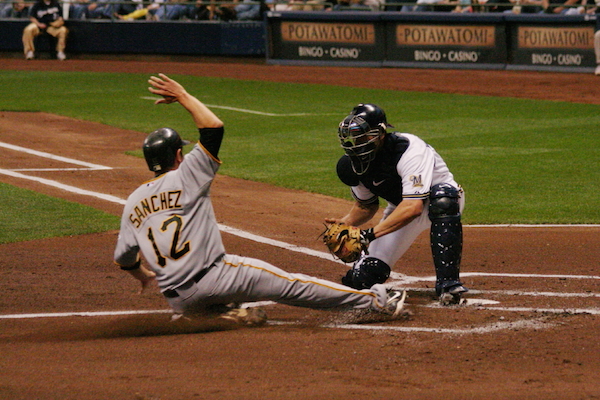
The bad call that you’re referring to is this one:

It won’t work:

Sports rules are complicated and the action happens very, very quickly. Assuming that there is no way that we’re going to be able to rework the rules to change something as integral as “if the catcher has the ball in his glove and touches the runner before he touches home plate, he’s out” then one has to wonder how technology will help. Setting aside video replay for a second, let’s look for another solution. Okay, so — let’s put a chip in the ball. Then, let’s put some material in the catcher’s glove such that the ball knows when it’s in the glove. Great — now we’re cooking with gas! Now we have to have either more material covering the runner’s uniform… and hands, arms, head, neck, etc. Or, I guess we could just monitor whether the glove is making contact by putting some sort of pressure meeter into the ball or glove. Except that won’t work because that glove could hit the ground, the ump, or the catcher’s own body. I’m not sure any of this will work, so let’s go back and examine video replay.

Video replay is the most common form of technology in sports. Football, basketball, hockey, even baseball (believe it or not) have some form of video replay in their rules. In baseball use of video replay is restricted to basically deciding whether a ball was a home run or whether it never left the ball-park, did leave but was subject to fan interference, or left but was foul (too far off to the side to count.) Other sports have more extensive video replay rules. You may have noticed NFL coaches comically struggling to get a little red flag out of their sock, pants, shirt, etc. and throw it onto the field — they are “challenging” the ref’s judgement and calling for a video replay. Every goal in hockey is reviewed by a team of video officials in Toronto. The NBA has been able to replay shots at the end of quarters and games and just recently added video replay for unclear out-of-bounds calls.

Tennis has a system called Hawkeye. This is probably as close as it gets to your suggestion. According to Wikipedia, “all Hawk-Eye systems are based on the principles of triangulation using the visual images and timing data provided by at least four high-speed video cameras located at different locations and angles around the area of play.” In tennis the rules are objective and there is technology which insures the calls are too. Or at least can be. The computer has not totally replaced the line-judges or the referee yet… although I could see a time in the not so distant future where they could.

Most other sports are not as tidy as tennis though. Take the call at home plate that started this discussion: here’s how Jonah Keri described it on Grantland.com

If you want to use replay to make a simple yes or no call, you won’t get unanimity. And no, the fact that Lugo acted as if he were out does not constitute iron-clad proof.

Watch the replay for yourself, with the sound off.

Here’s what I did see: Lugo starts his slide well in front of the plate. Home plate umpire Jerry Meals starts to make his safe sign just as Lugo touches home with his right foot. There’s no way Meals has time to process the play and rule that Lugo had already touched home. He’s also not looking at Lugo’s foot, but rather at the swipe tag. (It should be noted that Lugo did in fact touch home with his right foot the first time — the follow-up tap of home with his left foot was unnecessary.)

Either way, replay wouldn’t have resolved the issue. Not to the point where all parties, including a purple Clint Hurdle, would have been satisfied.

And, as Keri also points out, at the time of this call, the ump had been on the field working in a high-pressure environment for six hours and 39 minutes. Furthermore — even Baseball is a nice tidy game compared to Hockey or Football. No matter how many cameras, sensors, and computers you have, there is no chance in hell you’ll be able to figure out what happened at the bottom of a pile with thousands of pounds of angry football player fighting over the ball.

More tomorrow…
Ezra Fischer