
Susan
Word to the wise though — do not actually shout “and one” in a board meeting. That won’t go over well.
Thanks for reading,
Dean Russell Bell
An advice column for people who live with people who live for sports
Word to the wise though — do not actually shout “and one” in a board meeting. That won’t go over well.
Thanks for reading,
Dean Russell Bell
Dear Sports Fan,
How long is an NBA basketball game? I thought it was an hour long — made up of four fifteen minute quarters — and that I just kept missing the start of the quarter. Now someone tells me it’s four twelve minute quarters. Is that true? Why would a game be forty eight minutes. Seems arbitrary!
Thanks,
Sandra
Dear Sandra,
Rest easy, you were not missing the game! An NBA basketball game is forty eight minutes long and made up of four twelve minute quarters. I suppose you’re right that this seems a little arbitrary because the duration of most of the other big sporting events in the country do seem to end on a “ten.” Football is sixty minutes, made up of four fifteen minute quarters. Hockey is also sixty minutes, although it is divided into three twenty minute periods. Soccer is ninety minutes long, divided into two forty five minute halves. Baseball is essentially timeless — no clock is used to determine when the game ends. NBA basketball seems to be an outlier. Basketball is also the only main sport that differs in how long it is between college and professional games. A college basketball game is forty minutes, divided not into quarters but into two twenty minute halves.
So what gives? According to the original rules of basketball written by James Naismuth, “The time shall be two fifteen-minute halves, with five minutes rest between.” Not to get too far off topic, but the invention of basketball is pretty funny. Naismuth became a phys-ed teacher at a YMCA in Springfield Mass in 1891 and soon after invented basketball. Here is the Wikipedia explanation of why:
At Springfield YMCA, Naismith struggled with a rowdy class which was confined to indoor games throughout the harsh New England winter and thus was perpetually short-tempered. Under orders from Dr. Luther Gulick, head of Springfield YMCA Physical Education, Naismith was given 14 days to create an indoor game that would provide an “athletic distraction”: Gulick demanded that it would not take up much room, could help its track athletes to keep in shapeand explicitly emphasized to “make it fair for all players and not too rough.”
By the time the NBA (then the Basketball Association of America) came into being, the college game with its twenty minute halves was well established. The first franchise owners decided to lengthen the game for their league from forty minutes “so as to bring an evening’s entertainment up to the two-hour period owners felt the ticket buyers expected.” Today, the average “real-time” length of an NBA game has crept up to right under two hours and twenty minutes according to the blog Weak Side Awareness.
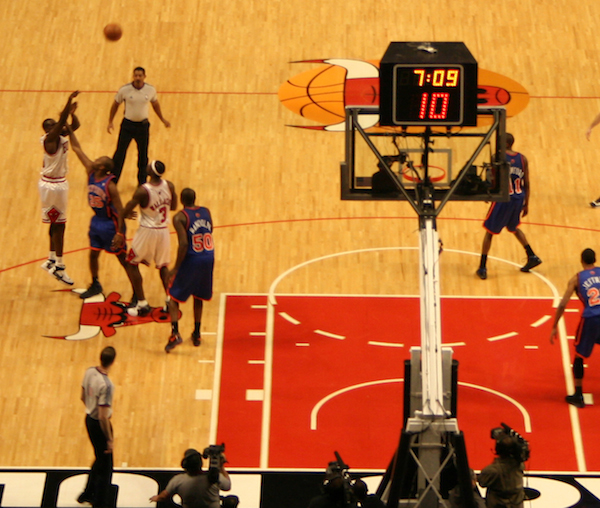
As for whether or not all this is arbitrary, I can’t say, but in thinking about this, I did notice that the NBA shot clock — a team must shoot the ball and at least hit the rim before this time expires or else the ball is given to the other team — is 24 seconds; another product of twelve!
Thanks for the question,
Ezra Fischer
Dear Sports Fan,
I’ve been watching some basketball and towards the end of games the announcer will sometimes say that a team has a “foul to give.” What does that mean?
Thanks,
Doug
Dear Doug,
In the NBA each player can commit five fouls before getting kicked out of the game for good on the sixth. A team cannot get kicked out of a gave for fouling too many times (although Chuck Klosterman wrote a great story about a team winning with only three players left at the end of the game) but there are consequences for fouling a lot. We’ll get to what these consequences are in a second, but first we have to quickly define a few different types of fouls.
Only defensive fouls count towards the team total. The count of team fouls resets to zero at the start of each quarter. On fouls one through five the player who is fouled will shoot two free-throws only if the foul was a shooting foul. After the fifth foul, from foul six until the end of the quarter, the player who is fouled shoots two free-throws for any defensive foul — no matter if they were shooting or not when fouled. This state of being for a team is called “the bonus.”
Okay — we finally have enough background to answer your question. Having a foul to give means that a team has not yet reached the fifth foul of the quarter. In other words — they can still foul the other team at least once before the other team is in the bonus and will shoot free throws when fouled. At the end of a game or quarter, having a foul to give is particularly useful because a defensive team can use it to disrupt the other team’s plans. If the offensive team has fifteen seconds left, they can set up a nice play to run but the team with a foul to give can wait until there are about three or four seconds left and then give that foul (i.e. foul the player with the ball.) Because the other team is not in the bonus, they will not shoot free-throws, they will just get the ball back and have to pass it in from out of bounds and try to run another play but this time with only a few seconds.
Thanks for the question,
Ezra Fischer